Blogging is not only writing articles and publishing them. There are many other works also. Need to find keywords, create images, check website traffic, improve SEO, check grammar mistakes and sometimes check website speed also.
Doing all these works manually can take more time. Because of that, many bloggers are using blogging tools. These tools can make the work little easy. Some tools help with SEO. Some tools help with images. Also, some tools help to check traffic and content mistakes.
Nowadays, many blogging tools are available on the internet. Some tools are free and some tools are paid. But every blogger no need to use all the tools. First, use the tools that are useful for your blogging work. After that, based on your blog growth, you can try other tools.
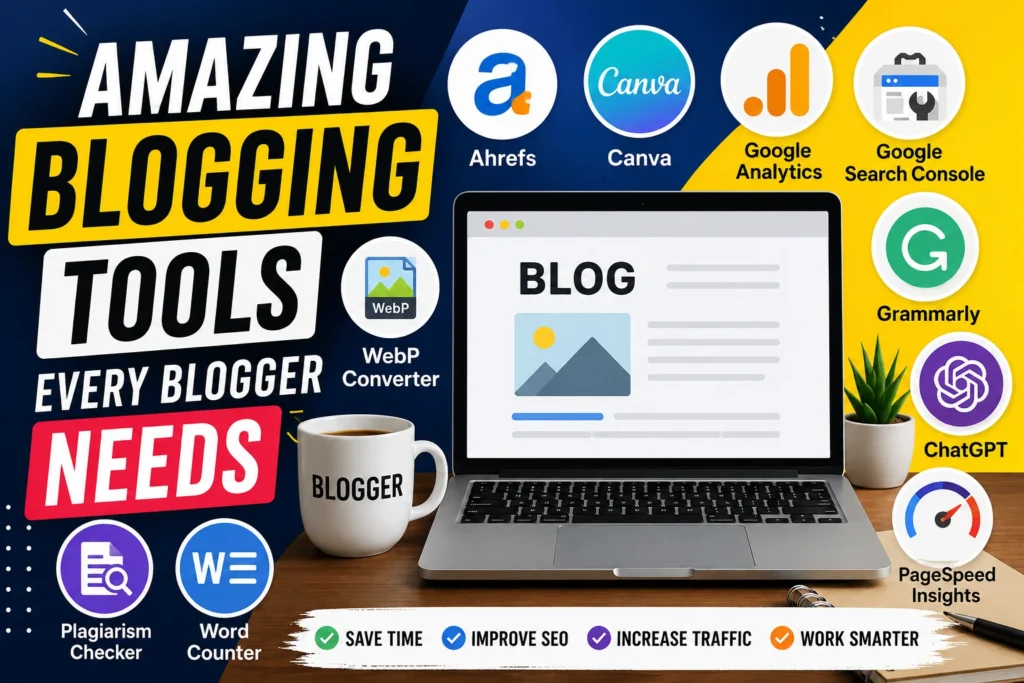
Blogging Tools
Blogging tools are useful for different works. A blogger may need one tool for keyword research and another tool for image creation. Also, traffic checking and grammar checking tools are needed for many bloggers.
For new bloggers, these tools can be very helpful. Because in starting time, many works are confusing. So, using the right tool can save time and make the blogging work little simple.
Now, next see some useful blogging tools every blogger should know.
1. Ahrefs
Ahrefs is a popular SEO tool used by many bloggers and website owners. It is mainly useful for keyword research, backlink checking and competitor checking.
If you want to write a new article, first you need to know what people are searching. Without keyword research, sometimes we may write articles that no one is searching for. So, Ahrefs can help to find keyword ideas and also show keyword difficulty.
Also, Ahrefs has backlink checker. This is useful to know which websites are linking to your blog. Bloggers can also check competitor websites and understand what type of content is getting traffic.
Though, Ahrefs is not fully free. Some free tools are available, but many advanced features are in paid version. Still, many bloggers are using it for SEO research. If you want to explore Ahrefs, you can visit their official website and check the available SEO tools.
2. WebP Converter
Images are important for blog posts. Because articles with images usually look better and visitors can understand the content easily.
But large images can slow down the website. Many bloggers upload PNG or JPG images directly on the website. Because of that, the image size becomes large and the page loading speed may reduce.
WebP converter is useful for this. It can convert PNG or JPG image into WebP format. WebP images are usually smaller in size compared to normal images. So, the webpage can load little faster.
Using WebP images is good for blogs that use many images. Before uploading the image to the website, converting it into WebP format can help reduce page size.
3. Canva
Canva is a useful tool for creating blog images. Many bloggers are using Canva for blog thumbnails, featured images, Pinterest images and social media posts.
Creating images manually is not easy for everyone. Because not every blogger knows graphic design. So, Canva becomes useful for beginners and normal bloggers.
The good thing is, Canva has many ready-made templates. You can choose a template, change the text, add your image and download it. So, creating blog images becomes simple.
The free version of Canva is enough for many bloggers. Though, some templates, images and design elements are available only in paid version. Canva can be used directly from the browser, so there is no need to install any software.
4. Google Analytics
Google Analytics is used to check website traffic. After publishing articles, every blogger wants to know how many visitors are coming to the website.
This tool can show traffic, page views, traffic source and visitor activity. So, bloggers can understand which pages are getting more visitors and which pages are not getting enough traffic.
Also, it has real-time report. This helps to see visitors who are currently active on the website. For bloggers, this is useful to understand how visitors are using the website.
Google Analytics is free to use. So, many bloggers are connecting it with their website for traffic checking. Bloggers can create an Analytics account and connect it with their website to monitor visitors and traffic sources.
5. Google Search Console
Google Search Console is one of the important tool for bloggers. It helps to check how the website is performing on Google Search.
Using this tool, bloggers can see clicks, impressions, search queries and indexing status. If any page is not indexed, the issue can be checked inside Search Console.
Also, bloggers can submit sitemap and request indexing for new pages. This is useful when publishing new articles or updating old articles.
Nowadays, most bloggers are using Google Search Console. Because it gives useful information about Google search performance. After verifying the website, bloggers can start checking indexing and search performance reports.
6. Grammarly
While writing articles, small mistakes can happen. Sometimes spelling mistake. Sometimes grammar mistake. Also, punctuation mistakes can happen while typing fast.
Grammarly helps to find these mistakes. Many bloggers are using Grammarly before publishing articles. It can show spelling mistakes, grammar issues and some sentence problems.
The free version is enough for basic checking. But don’t fully depend on Grammarly. Because sometimes tools may change the sentence tone. So, after checking with the tool, read the article yourself also.
This is useful because your content should sound natural to your readers.
7. Plagiarism Checker Tools
Plagiarism checker tools are useful to check copied content. Before publishing article, it is good to check whether the content is unique or not.
Sometimes content may match with another website without knowing it. Also, if you are using guest writers or freelance writers, plagiarism checking becomes more important.
There are many plagiarism checker tools available online. Some popular tools are DupliChecker, SmallSEOTools and PrePostSEO.
Most free tools have word limit. So, if the article is long, need to check the content in small parts.
8. Word Counter
Word Counter is a simple tool, but it is useful for bloggers. It helps to count words, characters, sentences and paragraphs.
While writing long articles, bloggers may need to know the total word count. Also, for meta description and social media captions, character count is useful.
Some word counter tools also show reading time. This can help bloggers understand how long the article may take to read.
So, even though it is a small tool, many bloggers use it regularly while writing content.
9. ChatGPT
Nowadays, many bloggers are using ChatGPT for blogging work. It can help to get blog topic ideas, title ideas, article outline and content improvement ideas.
Sometimes bloggers don’t know what topic to write next. In that time, ChatGPT can give some ideas. Also, it can help to arrange the article structure.
But don’t copy and publish everything directly. Because every blog has its own tone and style. So, use ChatGPT as a helper tool and edit the content in your own style before publishing.
This way, the content will look more natural and suitable for your website.
10. PageSpeed Insights
Website speed is important for every blog. If the website loads slowly, visitors may leave the page before reading the article.
PageSpeed Insights helps to check website speed. It can show speed issues on mobile and desktop. Also, it can give suggestions to improve page loading speed.
For example, if images are large or some scripts are slowing the page, this tool can show those issues. After fixing the issues, bloggers can check the speed again.
Checking website speed sometimes is useful, especially after changing theme, adding plugins or uploading many images.
11. Rank Math or Yoast SEO
Rank Math and Yoast SEO are useful plugins for WordPress bloggers. These plugins help to add SEO title, meta description, sitemap and other SEO settings.
Also, these plugins give SEO suggestions while writing articles. For beginners, this is useful because some SEO settings become easy to manage.
But don’t follow every suggestion blindly. Because sometimes the article may sound unnatural if you only write for SEO score. First write content for visitors. After that, optimize it for search engines.
Many bloggers are using these plugins to manage basic SEO work on WordPress websites.
Final Words
Blogging tools are useful for bloggers. Because blogging has many works like writing, SEO, image making, traffic checking, grammar checking and website speed checking.
Tools like Ahrefs, Canva, Google Analytics, Google Search Console and Grammarly are useful for many bloggers. Also, WebP converter, plagiarism checker, word counter and PageSpeed Insights can help in daily blogging work.
No need to use every tool available on the internet. Use only the tools that are useful for your blog. A few useful tools are enough for most bloggers to make blogging work easier.